The Situation
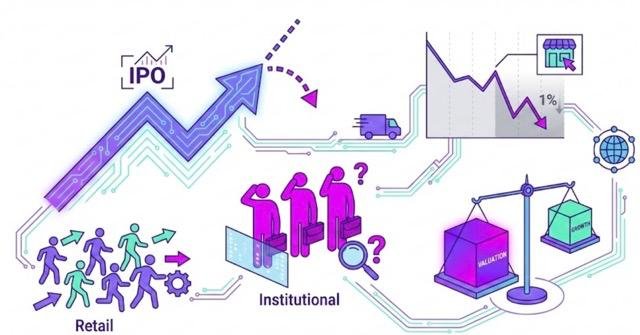
Shadowfax’s ₹1,907-crore IPO is limping toward a tepid close, with overall subscription hitting just 66% by the final day. While retail investors have oversubscribed their portion 1.87x—likely chasing the Flipkart brand association—Qualified Institutional Buyers (QIBs) have severely punished the issue, filling only ~0.4x of their quota.
The Grey Market Premium (GMP) has collapsed from double digits to a negligible 1–3% (₹1.5–₹4), effectively pricing in a flat or discounted listing. Despite 32% revenue growth and a claimed turnaround to profitability (₹21cr PAT in H1FY26), the market is rejecting the 62x EV/EBITDA valuation ask.
The “Growth Premium” is Dead:
Institutional capital is officially refusing to underwrite low-margin volume growth. Shadowfax trades at a staggering 170x annualized earnings with razor-thin EBITDA margins of ~2.9%. The refusal of QIBs to bite at this multiple—despite a 32% CAGR—signals a hard ceiling for asset-light logistics valuations.
Concentration Risk Reality Check:
The market views Shadowfax less as an independent platform and more as a captive utility for Flipkart and Meesho, who account for nearly 50% of revenue. When your largest customer is also your largest shareholder selling into the IPO, smart money interprets the “platform play” as a disguised vendor financing exit.
Second-Order Effect:
This failure will freeze late-stage liquidity for other high-burn, low-margin commerce enablers (e.g., quick commerce dark store operators). Expect upcoming IPO pricing discussions to shift violently from “Revenue Multiples” to “Free Cash Flow Yield.”
Founder Action
Audit Your Quality of Revenue:
If >30% of your revenue comes from <3 clients, you do not command a tech multiple; you command a consulting multiple. Diversify your book before you attempt to price your equity.
Abandon “Adjusted EBITDA” Narratives:
Shadowfax’s “Adjusted EBITDA positive” story failed to impress because the net margins remained <1.5%. Build a business that generates cash on a net basis, or prepare for a down-round.
Capital Efficiency Benchmark:
Shadowfax achieved a 4x capital turnover ratio (revenue generated per dollar raised), which is excellent. Replicate this asset-light discipline, but couple it with pricing power to survive the public market scrutiny.