The Situation
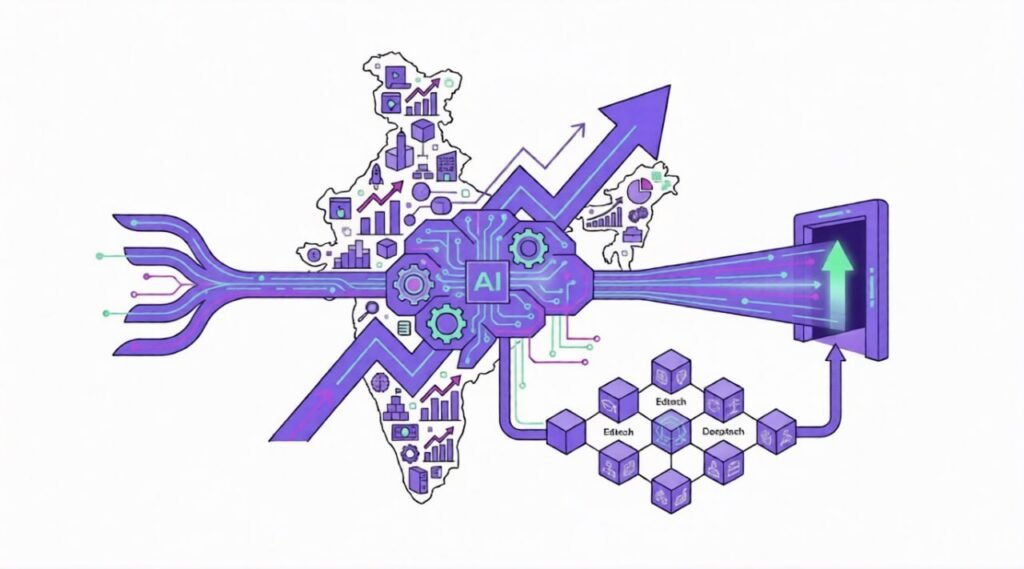
India has officially exited the “wrapper” era. On the 10th anniversary of the Startup India initiative (Jan 16, 2026), the ecosystem has hit a critical maturity milestone: 200,000+ recognized startups and 126 unicorns. But the headline volume metric hides the structural shift. The government’s IndiaAI Mission has successfully deployed 38,000 GPUs—nearly 4x the initial target—offering compute at a subsidized rate of ₹65/hour to domestic builders.
The days of “X for India” are dead. Capital flows have moved decisively from generic consumer plays to deeptech execution. While 2025 saw a record number of IPOs, the 2026 mandate is sovereign capability. The Ministry of Electronics and Information Technology (MeitY) has already selected 12 startups—including Sarvam, Soket, and Gnani AI—to build indigenous foundation models, backed by a ₹10,372 crore (~$1.25B) outlay.
Why It Matters
1. The “Compute Moat” is Democratized:
Founders previously bled capital renting Nvidia H100s from US clouds at $3-4/hour. India AI’s ₹65/hour (~$0.78) rate effectively subsidizes the R&D cost of deep tech startups by ~75%. This artificially lowers the barrier to entry for training models, not just fine-tuning them.
2. Sovereign Data > Global Weights:
The value is shifting to “Indic-first” workflows. Global models (GPT-5, Gemini) still hallucinate on complex Indian vernacular and diverse datasets. Sovereign models trained on local data (via the AIKosh platform’s 5,500+ datasets) are creating a defensive moat that Silicon Valley cannot easily replicate.
3. Valuation Re-rating:
Investors are no longer rewarding “growth at all costs.” The market has corrected: unicorn creation slowed in 2025 as VCs demanded profitability and deeptech IP over GMV. A startup utilizing sovereign compute to solve a specific Indian manufacturing or healthcare problem is now trading at a premium over a generic B2B SaaS wrapper.
Founder Action
- Audit Your Compute Costs: Immediately apply for the IndiaAI compute entitlement. If you are paying AWS/Azure list prices for GPU hours, you are burning runway unnecessarily.
- Build “Vertical,” Not “Vernacular”: Don’t just translate an app. Use the subsidized compute to train models on niche Indian datasets (e.g., legal records, agricultural soil data) that global models ignore.
- Target the “Tier 2” Supply Chain: 50% of recognized startups now originate from Tier 2/3 cities. The next unicorn won’t optimize grocery delivery in Mumbai; it will optimize supply chains in Jaipur or Indore using edge AI.