Tesla’s Space-Based Compute Pivot Escaping the Nvidia Tax
Tesla’s revival of the Dojo3 program for “space-based AI compute” is not a moonshot—it is a defensive fortification of the company’s $1 trillion autonomy valuation. By shifting Dojo3 to orbital infrastructure while locking in a $16.5 billion fabrication deal with Samsung for AI6, Elon Musk is attempting to physically decouple Tesla from the terrestrial compute supply chain dominated by Nvidia. This strategic pivot comes immediately after Nvidia’s CES 2026 release of “Alpamayo” an open-source reasoning model that commoditizes the very “chain-of-thought” autonomy Tesla spent a decade building.
The Situation
What Happened:
Elon Musk confirmed the restart of the Dojo3 supercomputer project, explicitly pivoting its purpose from FSD training to “space-based AI compute”. The decision follows the stabilization of the AI5 chip design and a massive $16.5 billion commitment to Samsung’s Taylor, Texas foundry to manufacture the subsequent AI6 generation.
The Numbers:
- $16.5 Billion: Value of Tesla’s multi-year deal with Samsung for AI6 fabrication, anchoring the Taylor facility through 2033.
- 9 Months: The new target design cycle for Tesla silicon (AI6 → AI7 → AI8), accelerating past the industry standard 18-24 month cadence.
- 81,000 H100s: Tesla’s current equivalent compute power, which Musk intends to dwarf with “oversupply” from proprietary silicon.
Why NOW:
Nvidia just commoditized the “brain” of the self-driving car. With the release of Alpamayo, Nvidia gave every OEM a “reasoning-based” autonomous stack that can explain its decisions eroding Tesla’s data lead. Tesla’s response is to move the battlefield from software (where Nvidia is winning) to infrastructure physics (space-based energy/compute), where Nvidia cannot follow.
Why It Matters
1. The End of the Data Moat
For years, Tesla’s valuation relied on its proprietary data fleet. Nvidia’s Alpamayo model neutralizes this by offering “physical AI” reasoning capabilities open-source. If a startup can download Alpamayo and achieve Level 4 reasoning, Tesla’s only remaining moat is cost-per-inference.
2. Vertical Integration as Survival
The $16.5 billion Samsung deal isn’t just capacity; it’s a burn-the-boats commitment to vertical integration. By owning the chip design (AI5/6) and the foundry capacity (Samsung Taylor), Tesla aims to reduce inference costs to levels Nvidia’s margin-stacking model cannot match.
3. Second-Order Effect: Orbital Datacentres
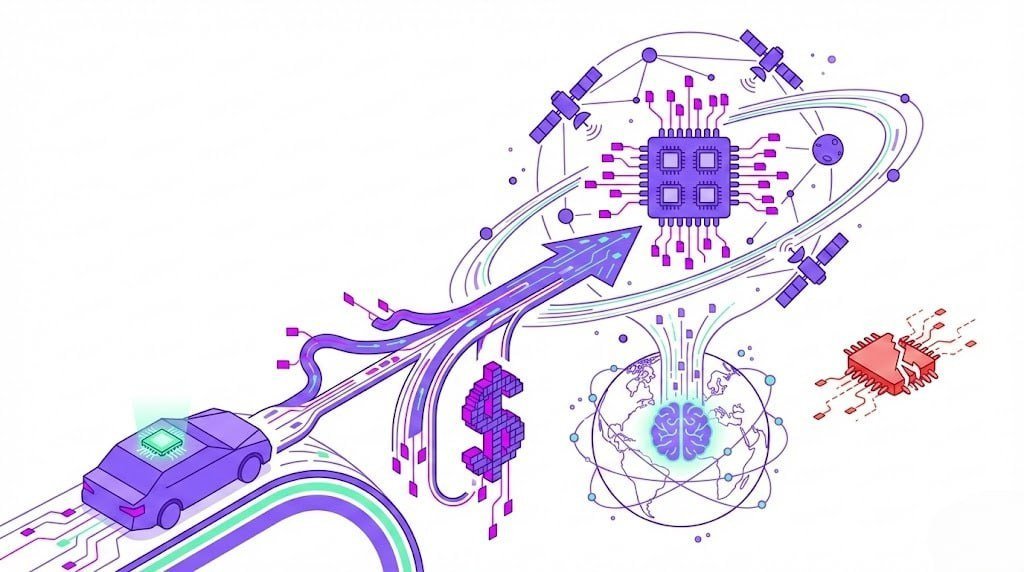
Dojo3’s “space” designation implies utilizing solar energy and radiative cooling in orbit to lower opex. If successful, this creates a bifurcated AI market: terrestrial compute for low-latency inference (cars) and orbital compute for massive non-time-sensitive training runs (Dojo), effectively bypassing local energy grid constraints.
Founder Action
- Audit Your Compute Dependency: If your business model relies on a proprietary “reasoning” layer, assume it will be open-sourced within 12 months. Shift value capture to proprietary data acquisition or physical infrastructure.
- The “Hardware Tax” Rule: Calculate your “Nvidia Tax” the percentage of your margin that goes to GPU providers. If it exceeds 15%, investigate dedicated silicon or bare-metal optimization immediately.
- Watch the 9-Month Cycle: Tesla is attempting to force a consumer-electronics pace (9 months) onto the semiconductor industry. If they succeed, the standard 2-year hardware depreciation schedule is dead. Shorten your infrastructure commit cycles accordingly.